Family PolypodiaceaeNative to Australia, Indonesia and New GuineaHabitat canopy epiphyte
Staghorn fern wants bright indirect light and water every 7 to 14 days, once the mount feels light and the fronds start to droop. Non-toxic to cats and dogs. It climbs: without support its leaves stay small.
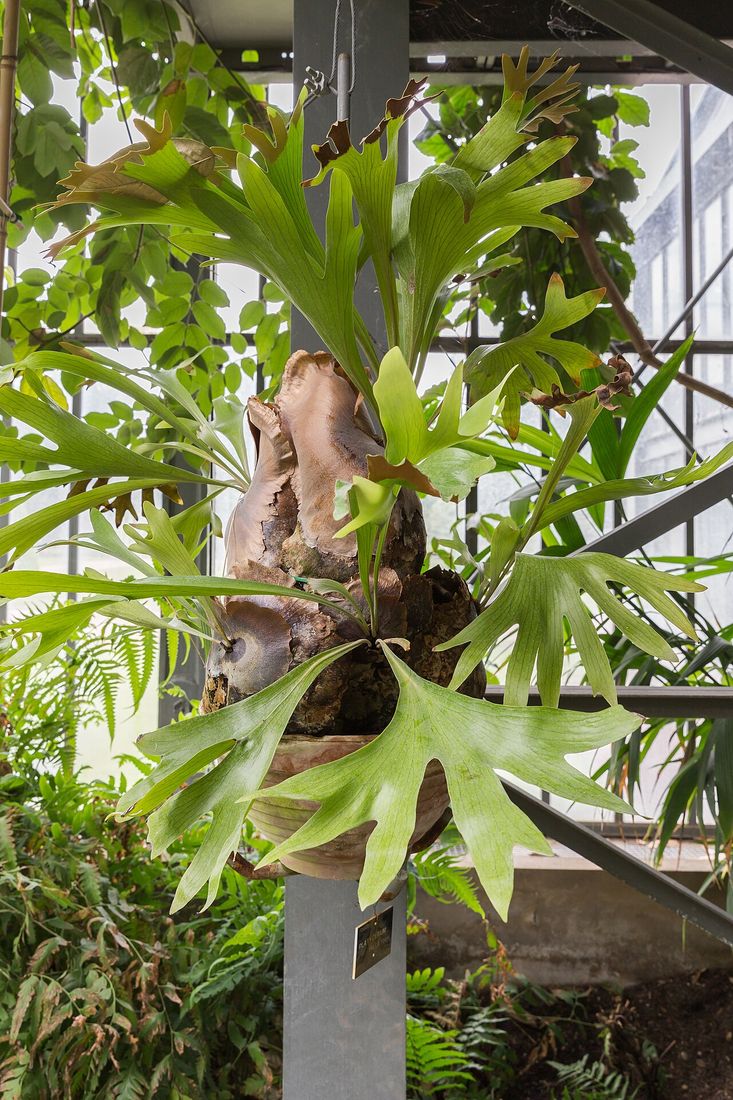
Platycerium bifurcatum. Photograph by Another one of my pictures: This photograph was taken by Medium69 (William Crochot) and released under the license stated below. You are free to use it for any purpose as long as you credit the author (William Crochot), the Source (Wikimedia Commons) and the license (CC-BY-SA 4.0) in close relation to the image. Please do not upload an updated image here without consultation with the Author. The author would like to make corrections only at his own source RAW. This ensures that the changes are preserved.Please if you think that any changes should be required, please inform the author.Otherwise you can upload a new image with a new name. Please use one of the templates derivative or extract., via Wikimedia Commons, CC BY-SA 4.0.
Light
Bright indirect
LowMediumBright indirectDirect
An east window, or three feet back from a south one. It is an epiphyte and grows mounted on wood rather than in a pot.
Water
Every 7–14 days
Baseline for a 6-inch pot indoors. Check first: water when the mount feels light and the fronds start to droop, not on a schedule.
Humidity
50% and up
Wants 70%. Struggles in dry winter air.
Temperature
55–80°F
Keep away from winter window glass and heating vents.
Difficulty
Moderate
Scores 3 of 5: Scores 3 of 5: undemanding once mounted, but it is watered by soaking the whole mount rather than pouring, and the flat shield fronds are supposed to brown and stay put rather than being pulled off.
Habit
Spreading
Needs a moss pole or board. Not decorative — leaves will not mature without one.
Non-toxic to cats and dogs
Eating a large amount of any plant can still cause mild stomach upset.
North Carolina Extension Gardener Plant Toolbox — Platycerium bifurcatum (consulted; entry exists and records no poison data.) Checked 2026-09-12.
Wikidata entity Q2170121 — taxonomy and entity identity.
Royal Botanic Gardens Kew, Plants of the World Online — Platycerium bifurcatum Accepted name; family Polypodiaceae. Checked 2026-09-12.
Missouri Botanical Garden Plant Finder — Platycerium bifurcatum Pest and disease guidance. Checked 2026-09-12.
Photograph: Another one of my pictures: This photograph was taken by Medium69 (William Crochot) and released under the license stated below. You are free to use it for any purpose as long as you credit the author (William Crochot), the Source (Wikimedia Commons) and the license (CC-BY-SA 4.0) in close relation to the image. Please do not upload an updated image here without consultation with the Author. The author would like to make corrections only at his own source RAW. This ensures that the changes are preserved.Please if you think that any changes should be required, please inform the author.Otherwise you can upload a new image with a new name. Please use one of the templates derivative or extract., Wikimedia Commons , CC BY-SA 4.0.
Compiled and edited by Tony Valcarcel · 2026-09-02 Tony Valcarcel is the editor and publisher of this database, not a horticulturist
or a veterinarian. Every fact above is drawn from the sources listed, and
toxicity severity is reported only where one of them stated it.
How this is sourced.
Last updated 2026-09-02